Three Artists, Three Different Worlds
Art comes in many forms, and each artist has their way of expressing ideas. Some focus on history and memory, while others celebrate fun and pop culture. Shuli Sadé and Maya Lin explore themes of memory, space, and history, but their approaches differ. Sadé uses photography, digital media, and data, while Lin builds large memorials and sculptures. Jeff Koons's work is completely different; his art is flashy, playful, and inspired by pop culture.
These three artists have unique ways of creating art. This blog post will look at how they approach their work and what makes each of them special.
Shuli Sadé
Shuli Sadé's art focuses on memory and how cities evolve. She layers images, data, and digital elements to show how places change and show traces of the past.
I got the chance to meet Shuli, who spoke about her piece, "Aqua Data," a custom laminated glass art wall with photographic interlayers. She created it for the Partners HealthCare building in Somerville, MA. All photographs used in the piece were taken by Sadé on-site and in Boston before the artwork was created, embedding a sense of location and memory into the work.
One of her recent projects, "Shades of Red," is made of layered wood panels and woodblocks painted with two shades of red: Old Glory Red from the American flag and the red from the Mexican flag. The two shades blend together in the center, representing harmony between two nations. The arrangement of the woodblocks emphasizes how urban spaces are always shifting.
Sadé presents memory as constantly shifting, just like the cities she portrays. Rather than creating one clear picture of history, her work with memory is a multi-layered experience.
 Image: Aqua DataArtist: Shuli SadeTitle: Aqua DataDate:2016Medium: Photographs and Laminated GlassDimensions: 12' x 31'

Maya Lin
Maya Lin works with landscapes and architecture to create spaces that help people reflect on history. While Sadé sees memory as ever-changing, Lin's goal is to preserve history in physical spaces that invite deep examination.
Her most well-known work, the Vietnam Veterans Memorial in Washington, D.C., is a perfect example. The reflective black granite wall, with the names of fallen soldiers, allows visitors to see their reflections in the names. This design makes history feel deeply personal.
Lin's work extends beyond war memorials. Her "Confluence Project" weaves Indigenous history into the landscapes of the Pacific Northwest, showing the deep connections between people and nature. Unlike Sadé, who shows memory as short-lived, Lin creates places where history is preserved. Her works are meant to be experienced, giving people space to pause and reflect.

Image: Vietnam Veterans Memorial Artist: Maya LinTitle: Vietnam Veterans Memorial Date:1982Medium: Made of black graniteDimensions: 246 feet 9 inches long. Wall meets at a 125-degree angle
Jeff Koons
If Shuli Sadé and Maya Lin focus on memory and history, Jeff Koons does the opposite. His art is not about reflection or meaning—it's about fun, eye-catching objects that celebrate everyday culture.
Koons is famous for his shiny, oversized sculptures of familiar things. His "Balloon Dog" series features giant, metallic sculptures that look like balloon animals but are made of stainless steel. Similarly, "Michael Jackson and Bubbles" is a glossy gold-painted statue of the pop star with his pet monkey. Koons' work is about mainstream culture and consumerism rather than historical or emotional themes.
Unlike Sadé and Lin, who want their work to make people think and feel, Koons embraces commercialism and pure fun. His work is playful and high-energy and doesn't deal with memory or history like Sadé and Lin do. Instead, his work is about turning everyday objects into larger-than-life objects meant to be visually impressive.
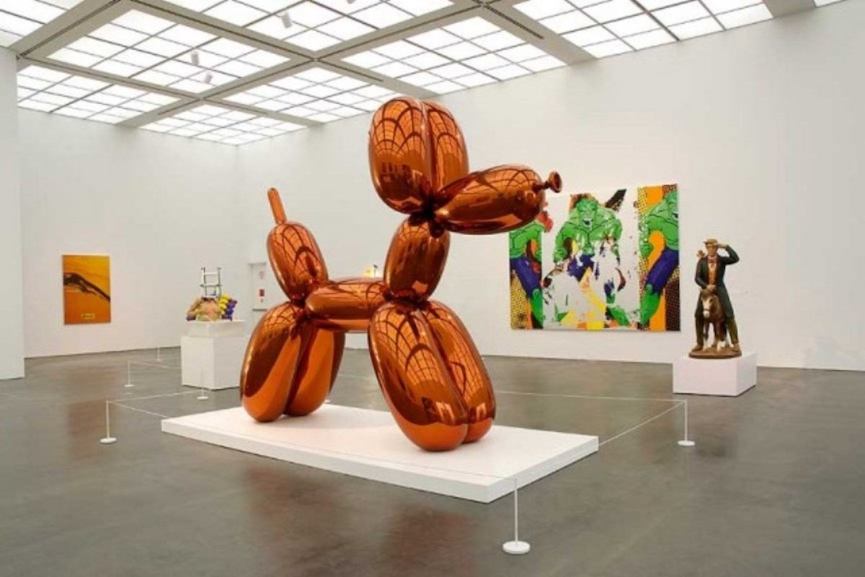
Image: Balloon Dog (Orange)
Artist: Jeff KoonsTitle: Balloon Dog (Orange)Date: 1994-2000Medium: Mirror-polished stainless steel with transparent color coatingDimensions: 121 x 143 x 45 inches
How These Three Artists Compare
Sadé, Lin, and Koons have completely different artistic goals:
- Sadé uses digital media, photography, and data to explore how cities and memory change.
- Lin builds memorials and landscapes that invite people to reflect on history.
- Koons creates big, playful sculptures that celebrate pop culture.
They also have different perspectives on time and meaning:
- Sadé shows memory as something that constantly evolves.
- Lin builds monuments that preserve history in a fixed space.
- Koons ignores memory and history, focusing on fun and entertainment.
One thing Sadé and Lin have in common is their interest in using space and mapping. Sadé transforms city maps and data into abstract visual layers, while Lin shapes landscapes to tell stories about history. However, Koons doesn't use space this way—his focus is on taking everyday objects and making them oversized, high-art.
Three Artists, Three Perspectives
Although Shuli Sadé, Maya Lin, and Jeff Koons are all successful artists, they each take a different approach to making art. Sadé explores memory and urban transformation through digital layering, Lin creates physical spaces that help people connect with history, and Koons makes eye-catching sculptures that celebrate pop culture.
Sadé's art is about change and shifting memories, Lin's art is about preserving history, and Koons' art is about visual fun. These three artists show us that art can take many forms—it can make us think, help us remember, or bring us joy. No matter what you're looking for in art, there's something for you.


Comments
Post a Comment